
An inspiring, collaborative, and evolving tool for a committed and responsible community center!
Faced with current environmental challenges, it is essential to change our consumption habits and take action, each of us at our own level, to support the ecological transition.
By signing the Green Community Center Charter in 2022, the Montchat Community Center (Lyon 3) affirmed its commitment to placing these issues at the heart of its practices.
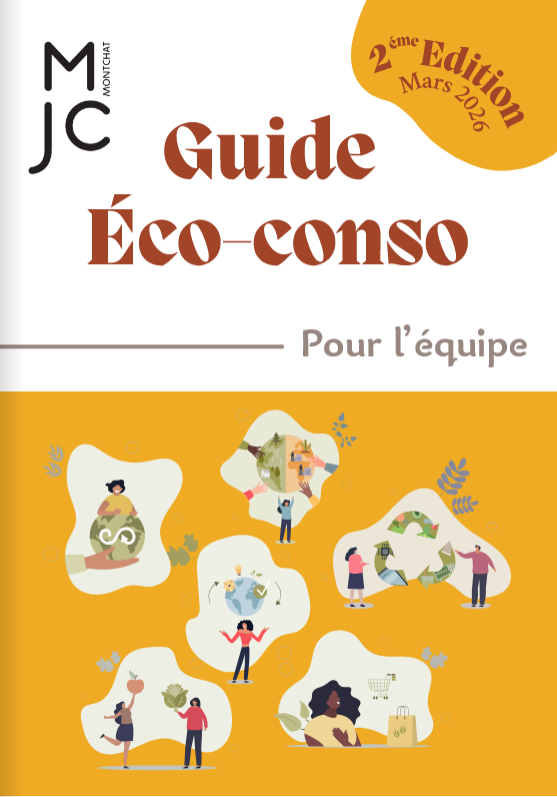
The eco-consumption guides, one for the community center staff and the other for members, were developed by the Green Community Center Commission, composed of two volunteers, Ninon and Cyril – board members, Mélanie – head of the Activities/Games department, and Nahia – a volunteer in the Ecology Civic Service program.
Ninon Voutay, president of the Montchat Youth and Culture Center (MJC), explains below the process behind the creation of these guides, with the aim of providing guidance, inspiring practices, and encouraging everyone to take action:
"The idea for this guide began two years ago, with the desire to work on the theme of consumption. In line with our association's mission, which emphasizes leading by example as a driver of change, we chose to start by evolving our internal practices before 'preaching' to our members. The idea was simple: to be able to say, 'Look, we can do it.'
This guide was therefore designed to inspire, but also to provide concrete answers to the questions that the teams might have. We were aware that we would be inviting people to make changes that were sometimes difficult, particularly regarding purchasing practices (especially the use of discount stores). That's why we supported this process over time: during team meetings, and then at each new school year or when new members joined.
After two years of implementation, we have We took the time to meet with the teams: listening, observing, taking notes… in order to create a new version truly adapted to our practices and needs. This new step also marks an important evolution: this guide is now our internal reference for consumption. The practices it contains are no longer optional, but constitute a common framework for the entire community center.
Everything isn't perfect yet, far from it, but progress is being made. The next step will be to monitor the implementation of these practices, support the teams, and find more sustainable solutions or alternatives when necessary.
Building on this experience, and convinced that these changes are possible, we chose to offer a parallel version for our members, to encourage them to evolve their own practices. The approach was to generate engagement through an appealing graphic design, concrete usefulness, and accessible solutions that can be used in many contexts, both professional and personal.
March 16, 2026